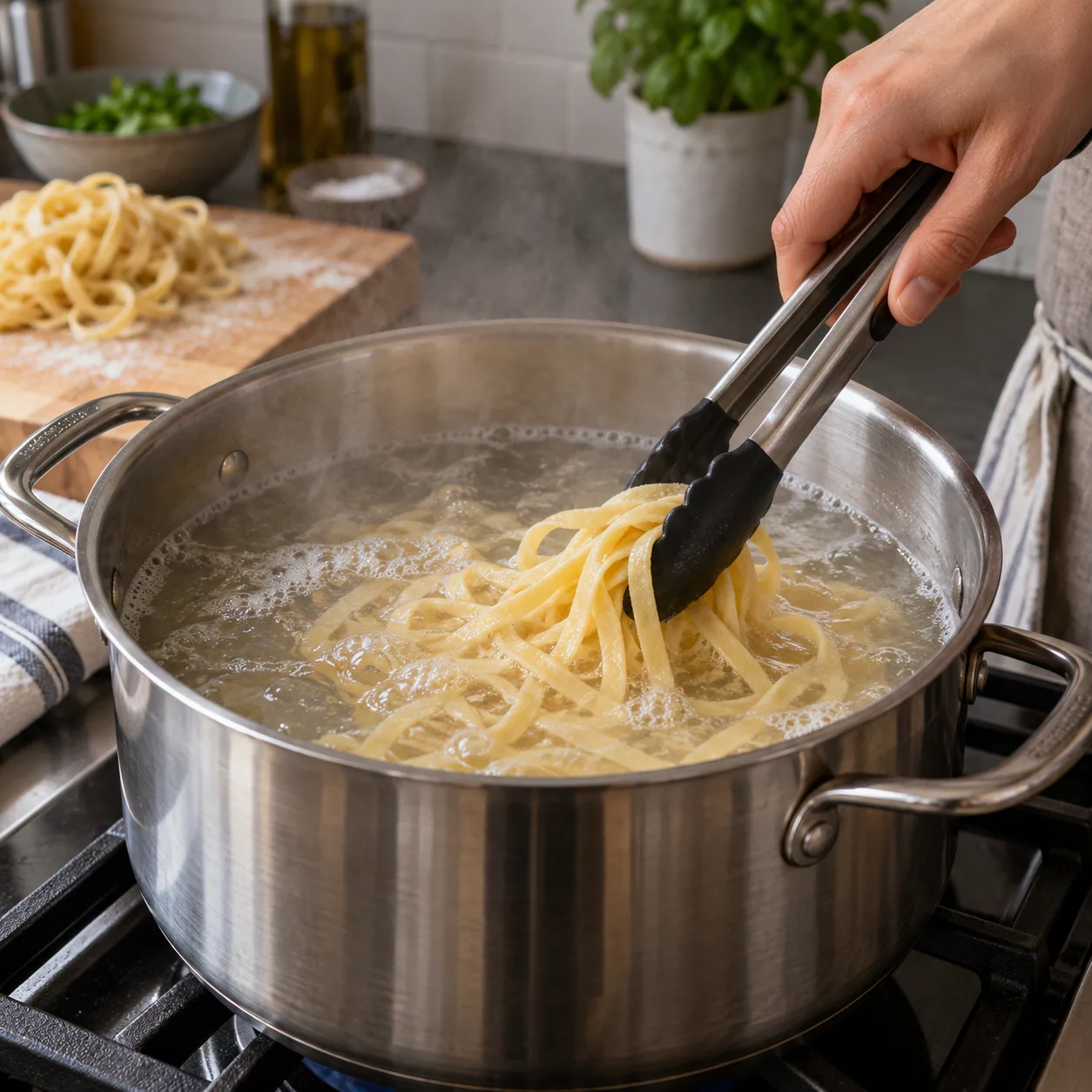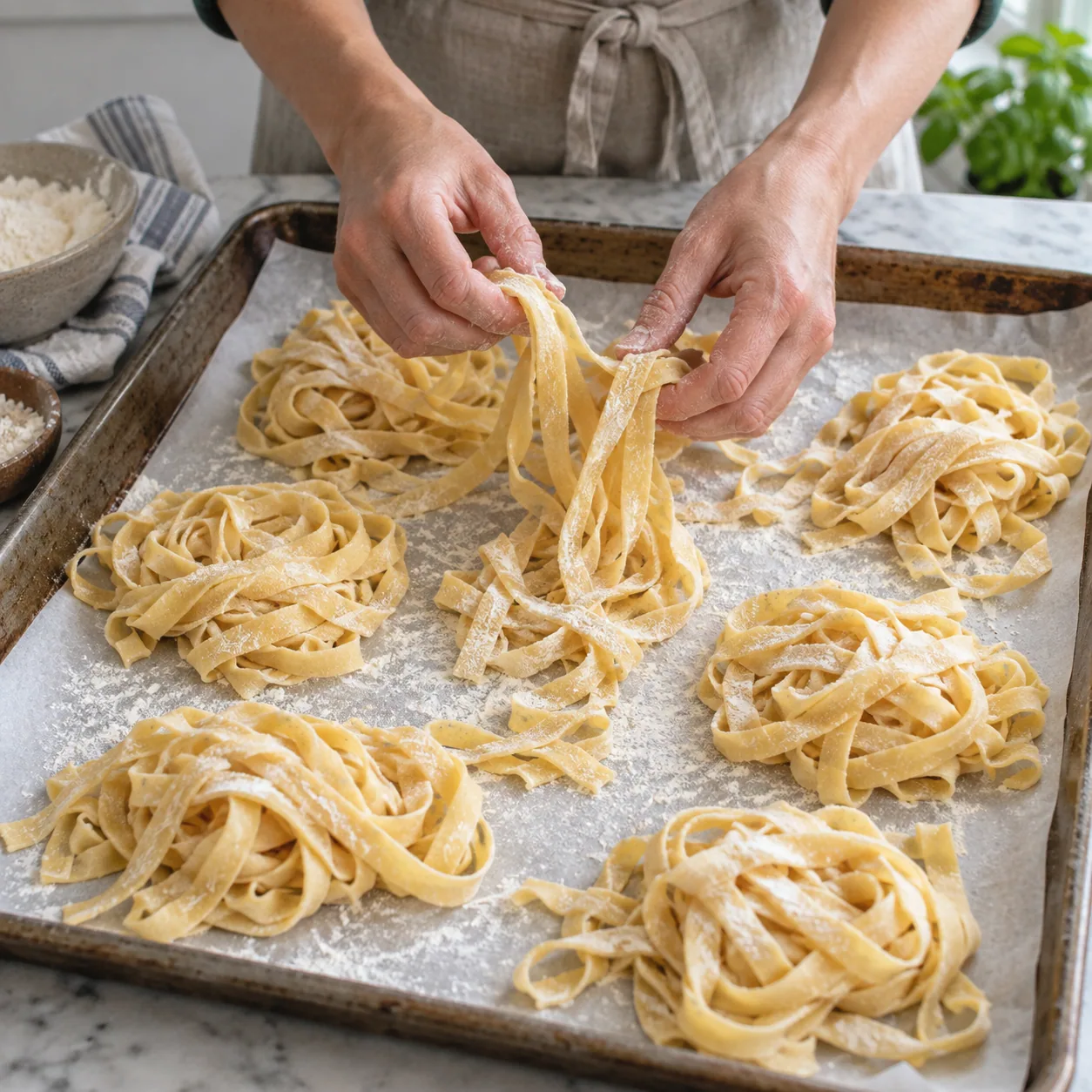
When fresh pasta sticks, identify when the strands joined. If they were already attached on the tray, fix the cutting and holding stage. If they were separate until they entered the water, focus on the first moments in the pot. Pulling apart a finished clump does not reveal which stage failed.
This guide is for unfilled cut pasta such as fettuccine or tagliatelle. Follow your chosen dough recipe for its flour, thickness, storage, and cooking time; those details are not interchangeable across every fresh-pasta formula.
If the strands stick immediately after cutting
Before cutting long ribbons, King Arthur Baking recommends letting the rolled sheets dry for 5 to 10 minutes per side, then dusting them generously with flour. The goal is not to dry the sheet until brittle. It should remain flexible enough to cut while its surface is less tacky.
After cutting, separate the ribbons and toss them lightly with flour. King Arthur’s fresh-pasta recipe then forms them into loose nests. If two strands cannot be separated without stretching or tearing, stop forming nests and return to the recipe’s dusting step rather than pressing more pasta into the pile.
Use this checkpoint:
- Sheet drags or adheres before cutting: follow the recipe’s flour-as-needed instruction and let the surface dry briefly.
- Cut edges join as soon as they meet: separate and dust the ribbons before nesting.
- Strands remain distinct: move them to the prepared tray without compressing the nest.
The 5-to-10-minute guidance comes from King Arthur’s long-ribbon method. Treat it as a starting point for that workflow, not a universal timer for every dough or room.
If the pasta sticks while waiting on the tray
Prepare the landing place before cutting. King Arthur’s recipe uses a semolina-dusted baking sheet and loose nests; its fresh-pasta guide also recommends keeping some shaped pasta in a single layer on a semolina-dusted tray. These methods reduce unnecessary contact while the pasta waits.
Do not use a tall, compact nest merely to save tray space. A useful nest is loose enough that you can still see separate ribbons. Keep batches apart on the tray, and use the recipe’s instruction to cook or freeze the cut pasta soon after shaping instead of leaving an uncovered tray as an indefinite holding method.
Before boiling, lift one nest gently:
- If strands fall apart with light handling, it is ready for the pot.
- If the outside moves but the center remains attached, separate what you can without tearing and correct the dusting or tray arrangement for the remaining dough.
- If the pasta has become an inseparable mass, do not assume boiling will restore distinct ribbons.
If separate strands clump after entering the pot
King Arthur’s fresh-pasta recipe instructs the cook to add the pasta to boiling water and stir. Its pasta class notes likewise say to stir briefly after adding fresh pasta. That first stir is the relevant action when the tray test showed separate strands but the pot produced a clump.
Use the cooking time from the dough recipe you actually followed. King Arthur gives about 3 to 4 minutes for its fresh-pasta recipe, while its class material gives about 3 to 5 minutes depending on size and thickness. Those ranges describe those formulas and shapes; tasting and the selected recipe remain more useful than transferring one fixed number to another dough.
Change one stage on the next batch
Record the first point where the strands joined: after cutting, during tray holding, or after entering the water. Then change the matching step—surface drying and dusting, tray arrangement, or the initial stir. Keeping the diagnosis tied to one stage makes the next batch more informative than adding extra flour everywhere.
Pasta By Hand has not kitchen-tested this troubleshooting guide. Its AI illustrations explain the workflow but do not document a cooked result.