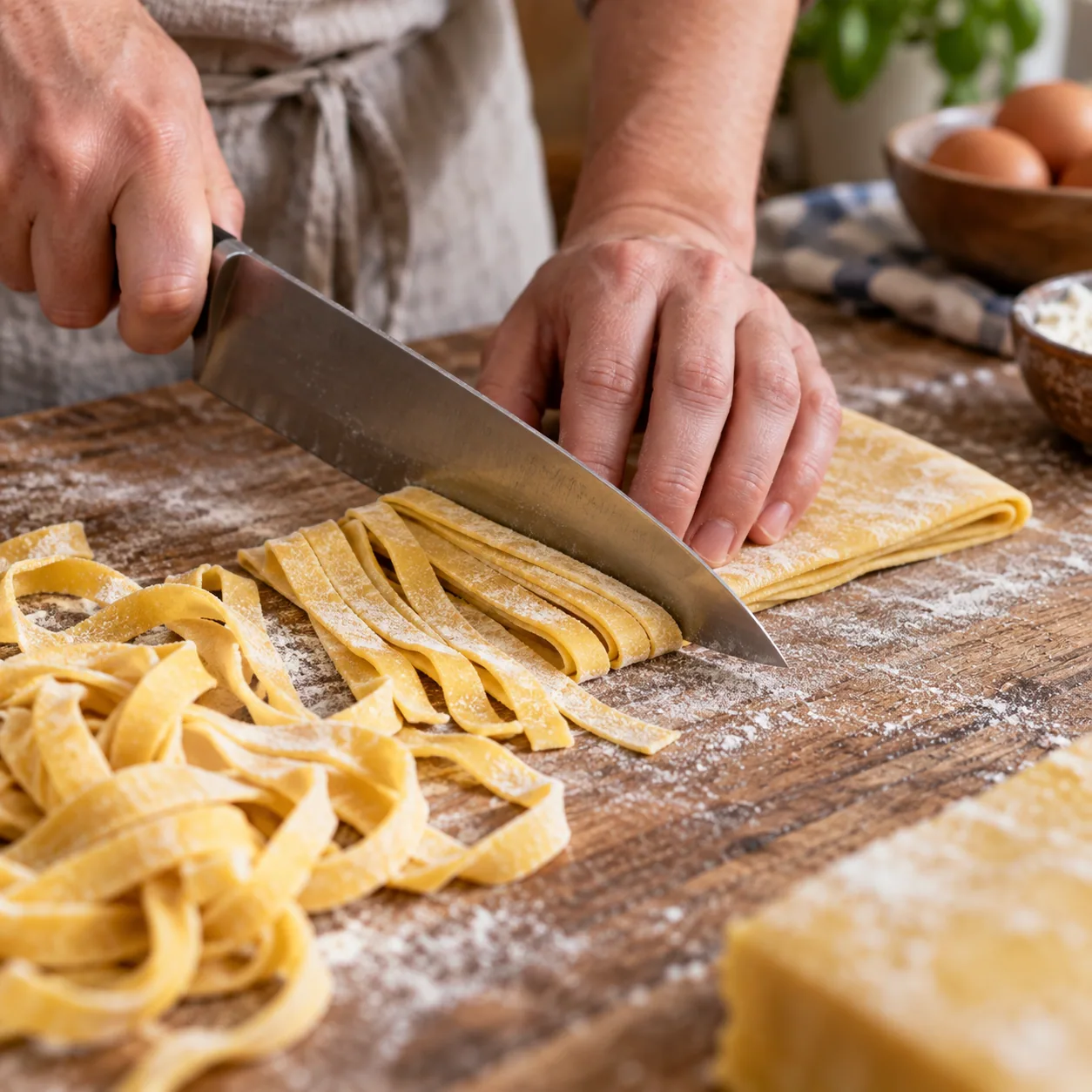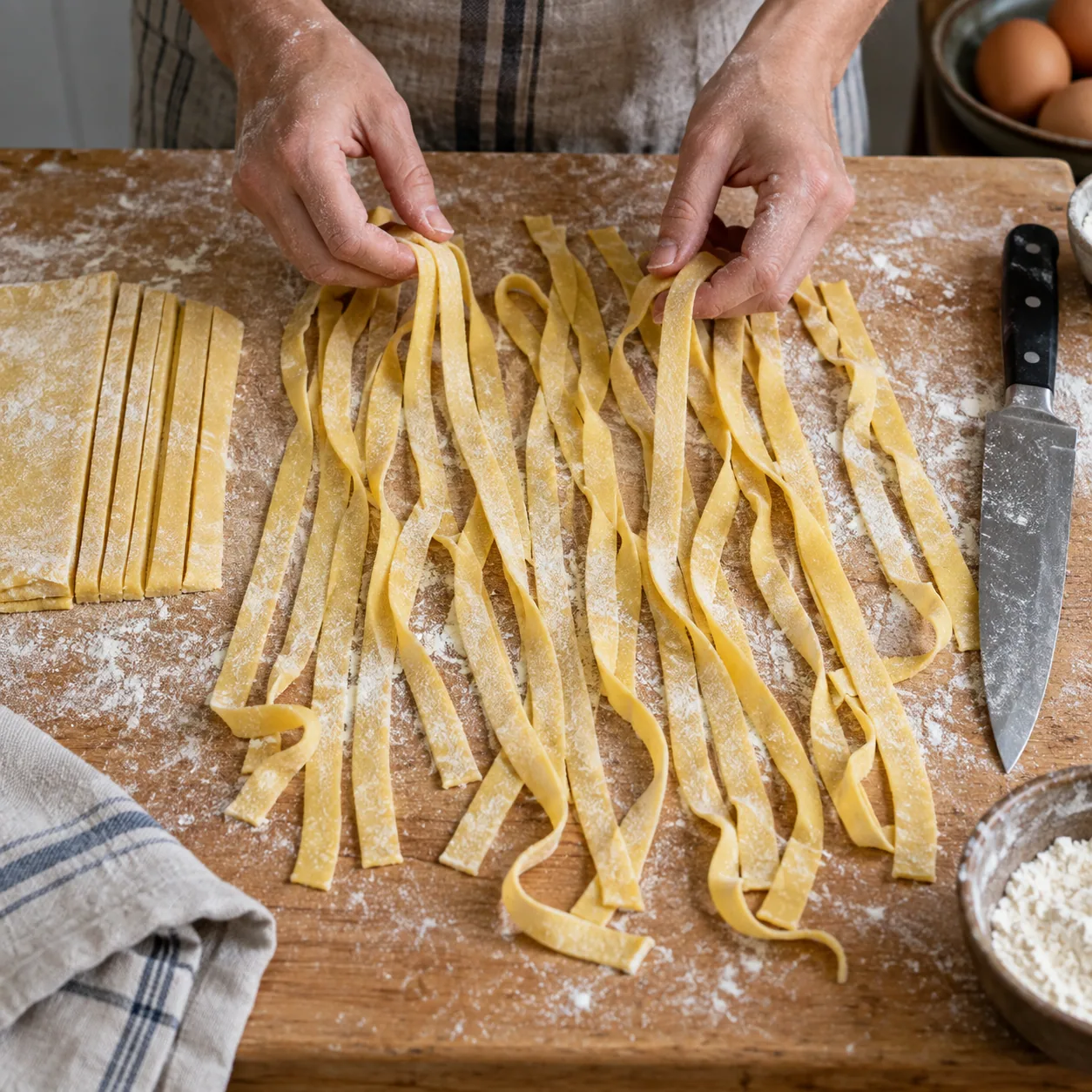
For more even hand-cut ribbons, work with one small, rested piece of pasta dough at a time. Roll the sheet to a consistent thickness, dust only enough to prevent sticking, fold it loosely, cut with a sharp knife, and open the strips at once. The goal here is repeatable home shaping—not a claim about one official regional width.
Set up for one sheet at a time
Begin with a fresh pasta recipe suited to rolling into sheets. King Arthur Baking’s general pasta guide distinguishes softer sheet doughs from the drier mixtures used for extrusion, so do not assume every pasta formula should behave the same way under a rolling pin.
Divide the rested dough as your recipe directs. Keep the portions you are not using covered; King Arthur’s fresh egg pasta class instructions make this explicit. Clear enough board space for both rolling and cutting, and use a stable cutting surface with a sharp chef’s knife.
Roll for thickness before you think about width
Flatten one portion, then roll from the center outward. Rotate the sheet often enough to notice a heavy center or a thin edge. A knife can make equal-width strips, but those strips will still cook unevenly if their thickness varies from side to side.
King Arthur’s guide to ribbon-cut shapes notes that pasta sheets can be rolled by hand and cut with a sharp chef’s knife. It also gives familiar ribbon widths as points of reference. For a first practice batch, consistency within your own sheet is more useful than chasing a millimeter target from a different dough or tradition.
If the dough repeatedly springs back, cover it and consult the rest instructions in its recipe. If it sticks, use the recipe’s dusting guidance rather than burying the sheet in flour.
Use a test fold
Before folding the whole sheet, dust both sides lightly and fold over a small edge. Lift it again. The surfaces should separate without tearing or smearing.
If they cling, unfold the sheet and correct the surface before cutting. If the test fold releases, make loose, manageable folds without pressing them into tight creases. You can also cut a small sheet flat if folding makes the dough harder to control; folding is a handling technique, not a requirement for the name.
Cut three strips, then stop
Make three parallel cuts at the width you intend to repeat. Open those strips immediately and place them side by side.
Check three things:
- Do the layers separate cleanly?
- Are the widths close enough to cook together?
- Does the center of each ribbon look about as thick as its edges?
This early check prevents an entire folded sheet from becoming a stuck bundle. If the knife drags or tears, address the knife, board, or sticky fold before changing the dough formula.
Continue cutting with your guide strips in view. Open each small group as soon as it is cut, then arrange the ribbons loosely on a lightly floured tray. King Arthur’s pasta guidance recommends flour to keep fresh-cut pasta from sticking. Avoid compressing the portions into dense nests where damp layers can hide.
Cook according to the dough recipe
Fresh-pasta cooking time varies with the formula and the thickness you rolled. Use the cooking directions attached to your dough recipe and begin checking as it approaches that range. King Arthur’s guide to drying pasta likewise advises checking frequently because recipes differ. A noodle floating is not, by itself, proof that its center has reached the texture you want.
Have the sauce ready before the pasta enters the water. If the first cooked ribbon is noticeably thick at its center, change the rolling of the next sheet rather than trying to solve every difference with extra boiling.
After the meal, record only the variables that will help next time: portion size, approximate thickness, chosen width, whether the test fold released, and whether the first ribbon cooked evenly. That is enough to make a second batch more consistent without pretending this untested editorial method is a traditional specification.
This article has not been verified through a Pasta By Hand kitchen test. Its images are AI-generated editorial illustrations.